
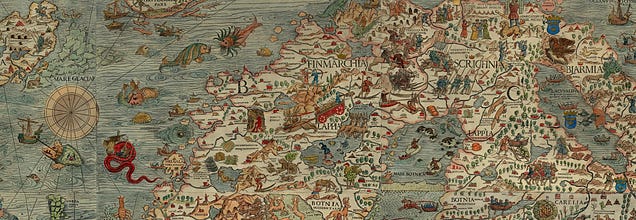

”A galaxy extends a thousand times as far as the moon and sun revolve and the dazzling ones light up the quarters. In that galaxy there are a thousand moons, a thousand suns, a thousand Sinerus king of mountains…”
Aṅguttara Nikāya AN 3.80: Cūḷanikāsutta. Translated from Pali by Bhikkhu Sujato.
Buddhist cosmology is a vast, multilayered system. Its roots stretch back thousands of years to the ancient Indian worldview. In Buddhist cosmology, our world is not the centre of the universe but only one world in a thousandfold cluster of worlds. There are many clusters like this, and one thousand world clusters form a bigger galactic cluster. One thousand bigger galactic clusters in turn form a galactic supercluster. These world systems are inhabited by different kinds of beings such as humans, animals, gods and hungry ghosts. Many early Buddhist texts described only one world system, but the number grew over time. Some, like the Cūḷanikāsutta, already mention as many as one billion worlds.
All world systems are governed by the law of karma, also known as the law of cause and effect. In Buddhist thought karma is seen as one of the laws of nature alongside laws such as gravity. Karma is neither good nor evil; it is not a sentient being, but rather the force influencing the lives of beings and defining their future rebirths. It is believed that all beings will be reborn endlessly into different lives and bodies until they reach enlightenment and break free from the cycle of rebirth. This endless cycle of rebirth is known as saṃsāra, which means ’wandering’ in Sanskrit. According to the law of karma, a being’s previous deeds and intentions plant the seeds of their next life. Good, generous deeds with virtuous intentions lead to pleasant consequences and lives. On the other hand, vile deeds leading to the suffering of others only bring suffering to the being committing the actions.
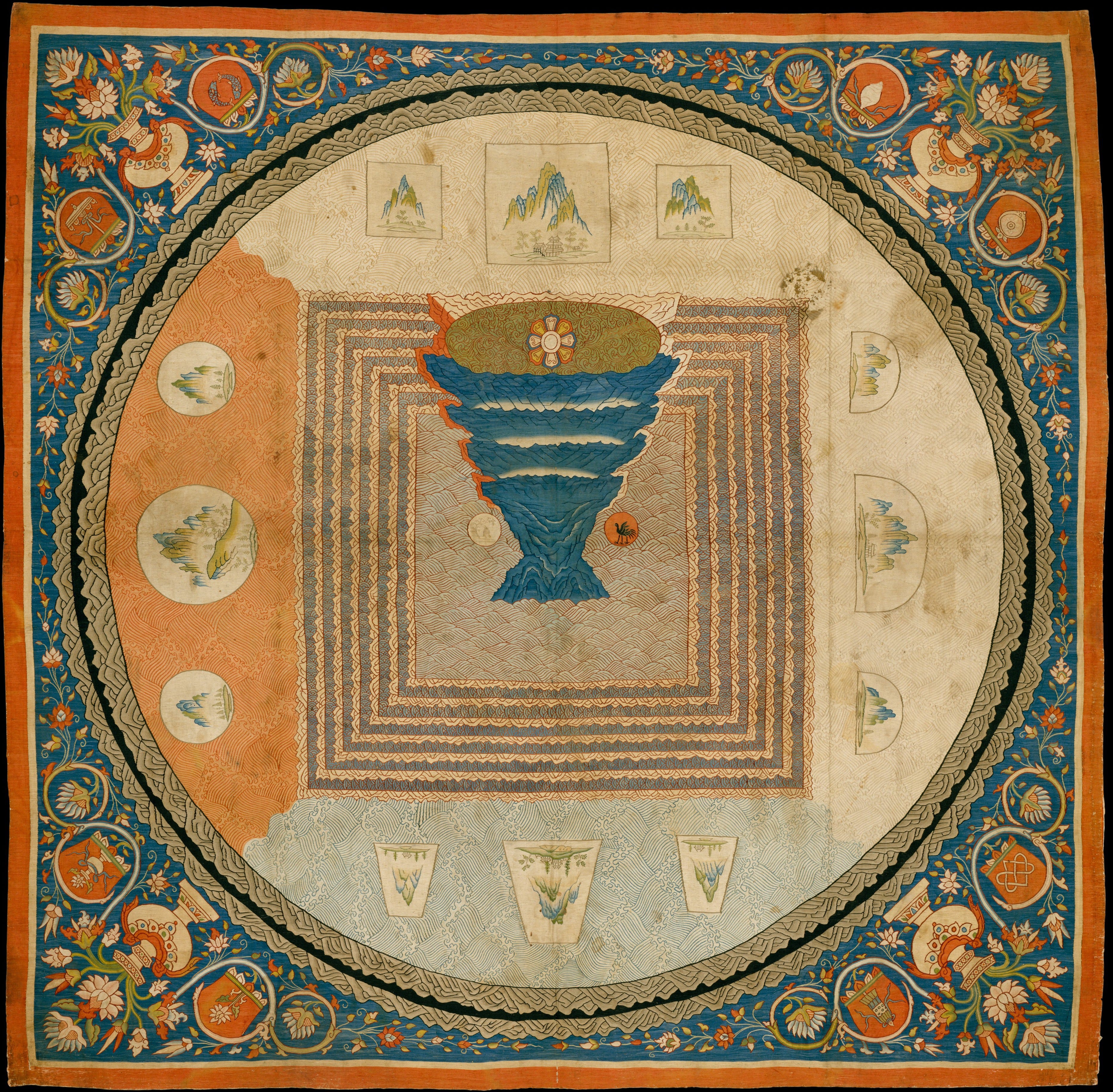
In Buddhist cosmology, the universe has no discernible beginning. Time is measured in vast units known as kalpas. A kalpa, aeon or world-cycle, is not usually given an exact length in the suttas. However, according to some traditions, it lasts 4,320 million years. Like beings, world systems are also part of the cycle of rebirth. Their life cycles have four phases. The first phase, the creation, begins when the wind of karma starts blowing. In the second phase the world system abides and various beings inhabit it. During the third phase, according to the Sattasūriyasutta, the world system is destroyed by the heat of seven suns. The fourth and last phase is nothingness. Eventually, out of nothingness, a new world system is born. Each of these phases lasts an ‘incalculable aeon’.
In the Pabbatasutta, a parable is used to help us understand how vast an aeon actually is. According to the parable, if someone stroked a mountain of solid rock with a fine cloth once every century, the mountain would be eroded before an aeon ends. Still, according to the Gaṅgāsutta, more aeons have passed than there are grains of sand in the Ganges River.
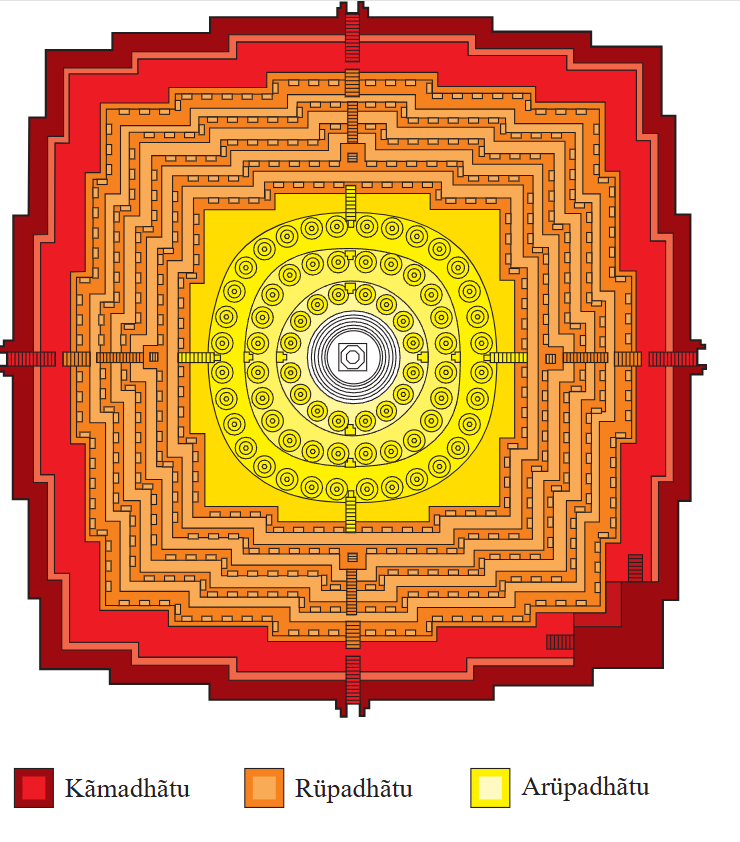
Besides numerous world clusters, the universe is divided into three realms, each more subtle than the one below it. The first is ’the realm of sense-desire’. It is inhabited by various beings, such as humans, animals and the gods of the six lowest heavens. Their perception of the world is dominated by their likes and dislikes. Above this realm lies ’the realm of pure form’ consisting of sixteen heavens. Its inhabitants are brahmā-gods, calm beings who are free from the sense-desire that dominates the realm below. They still have attachments and vices though, such as pride. The finest, most subtle realm is ’the realm of formlessness’. There, beings are completely free of any shape or form.
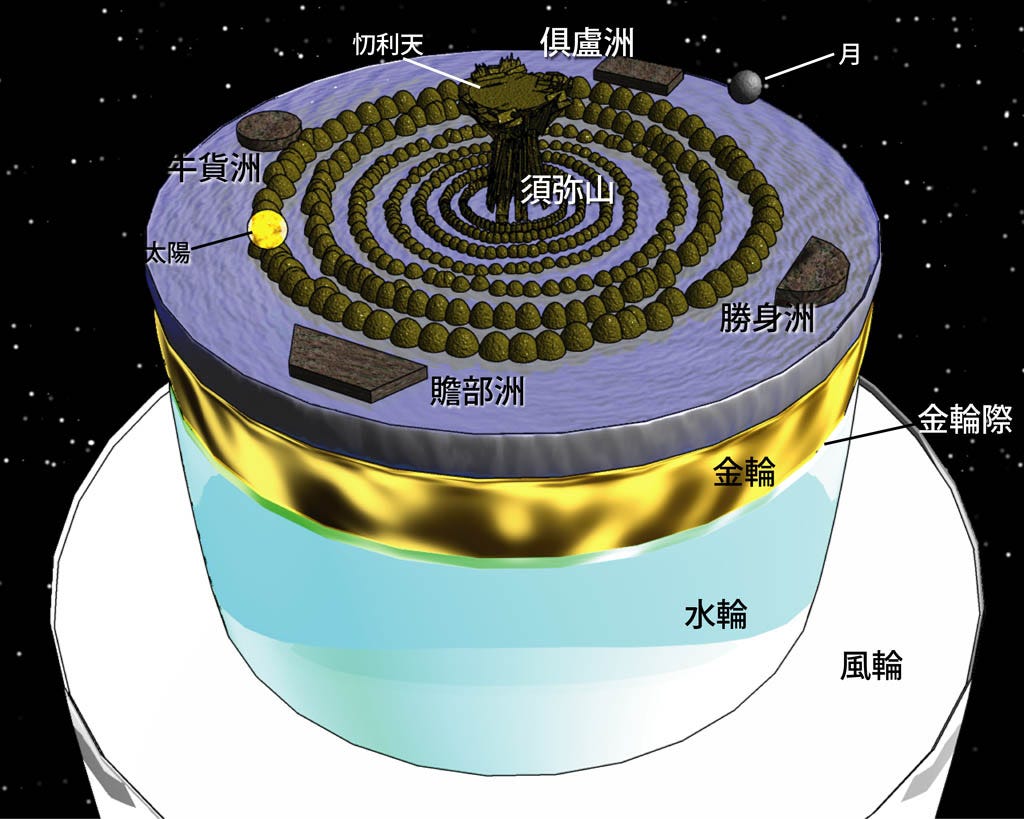
In the centre of every world system lies Mount Meru, also known as Sumeru and Sineru, the king of mountains. It is often associated with Mount Kailash. Like the axis mundi, or world axis, in other mythologies, Mount Meru connects heaven and earth. Altogether there are twenty-six heavens in Buddhist cosmology inhabited by various gods. The lowest of the heavens is the Heaven of the Four Great Kings, the rulers of the four cardinal directions. It is located on the slopes of Mount Meru, where each ruler has their own slope. The Heaven of the Thirty-Three Gods, Tāvatiṁsa, is thought to be located on top of Mount Meru. Higher heavens float above the mountain.
Mount Meru is a towering, square-shaped mountain. According to some legends, it radiates a golden glow. Mount Meru’s four sides are described as being made of precious metals and gemstones: gold, silver, lapis lazuli and crystal. It is surrounded by seven mountain ranges and seven seas. Beyond the last mountain range in the vast ocean lie four island continents in the cardinal directions. These continents are in turn surrounded by two thousand islands. The southern continent is called Jambudvīpa, ’Jambū continent’, receiving its name from jambu trees. It is often translated into English as the ’Rose apple continent’. Sujato, however, translates Jambudvīpa as ‘Black Plum Tree Land’. Jambudvīpa is the continent where humans live. According to legend, the continent faces the lapis lazuli side of Mount Meru. The reflection of the lapis lazuli paints the sky and the ocean blue.
In the next post, I will take you to the unknown lands on the edges of the map, to places that never existed.
Safe travels,
Piia
Further reading:
Bhikkhu Sujato (trans.): Aṅguttara Nikāya & Saṃyutta Nikāya. SuttaCentral.
Randy Kloetzli (1983): Buddhist Cosmology: From Single World System to Pure Land: Science and Theology in the Images of Motion and Light.
Richard H. Robinson & Willard L. Johnson (1996): The Buddhist Religion: A Historical Introduction.
Rupert Gethin (1998): The Foundations of Buddhism.
Donald S. Lopez Jr. (2001): The Story of Buddhism: A Concise Guide to Its History & Teachings.
John S. Strong (2001): The Buddha: A Short Biography.
Peter Harvey (2013): An Introduction to Buddhism. Second edition.
Ven. Brahmapundit & Peter Harvey (eds.) (2015): Common Buddhist Text: Guidance and Insight from the Buddha.