
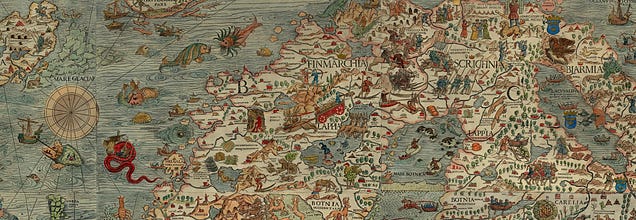

Earth, our home. Also known as the Blue Planet for shining like a bright blue gem in the pitch-black expanse of space. Around 71 percent of our planet is covered by water of which about 97 percent is held by the oceans. Yet we know astonishingly little about them. Water is the source of life. Without it, life couldn’t exist. Water is beautiful yet perilous element. No one knew this as well as sailors of old. During the time of Olaus Magnus (1490–1557) as many as half of those who set sail for distant seas never returned to shore. The clergyman cartographer wanted to educate and warn people of the dangerous waters. For that purpose Olaus Magnus populated his Carta Marina with strange and wondrous sea monsters. Here I shall introduce three of them: the Norwegian sea serpent, pristers and the island whale.
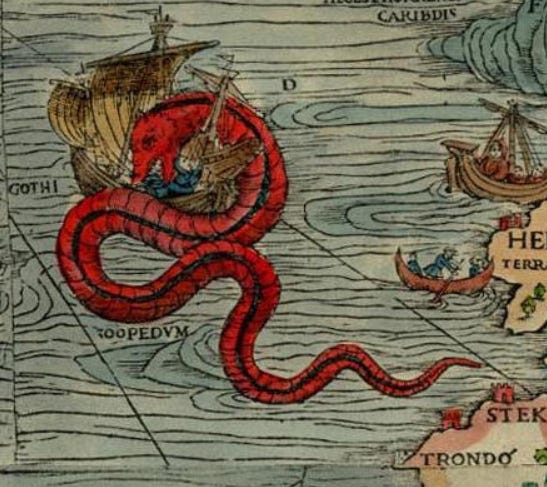
The Norwegian sea serpent
In the upper part of the map depicting the dangerous sea between Norway and Iceland a giant sea serpent coils around a helpless ship from Gothia. According to Olaus Magnus, the Norwegian sea serpent was a colossal one to two hundred feet long and twenty feet thick serpent dwelling in the rocky coast of Norway near Bergen. Its scales were razor-sharp and black, eyes flaming red and from the neck hung eighteen inches long hair. Norwegian sea serpent was a danger to sailors, crustaceans and even livestock on dry land, warned Olaus Magnus. He described how the giant sea monster slithered out from its cave during bright nights of summer to gorge on calves, pigs and sheep. Other times it chased crustaceans such as octopuses and lobsters through the waters to feast upon them. And when the wind died down it assaulted sailors onboard their ships. Towering upon ships like an enormous pillar it snatched men from the deck and gobbled them up.
Olaus Magnus considered the appearance of the Norwegian sea serpent to be an ill-omen for the state. According to him, if the sea serpent showed up, political upheaval would follow: princes would be driven into exile, they would die, or bloody wars would break out.
The giant sea serpent wasn’t an invention of Olaus Magnus. He based his description of the monster on Biblical passages and sailors’ tales. In the Bible in Job 41 a gargantuan sea monster known as Leviathan is described as a fierce, fire breathing beast whose mouth was full of ”fearsome teeth” and back covered by ”rows of shields tightly sealed together”. In Isaiah 27:1 Leviathan is depicted as ”the coiling serpent” and ”the monster of the sea”. Since Olaus Magnus was a clergyman it can be assumed that he was aware of these passages. Sailors, Olaus’ other source of information, described a 200 feet long gigantic sea monster lurking near the coasts of Norway. Researchers have tried to figure out what was the real animal behind the Norwegian sea serpent. They have suggested various different marine animals from seals to giant squids and whales to oarfish.
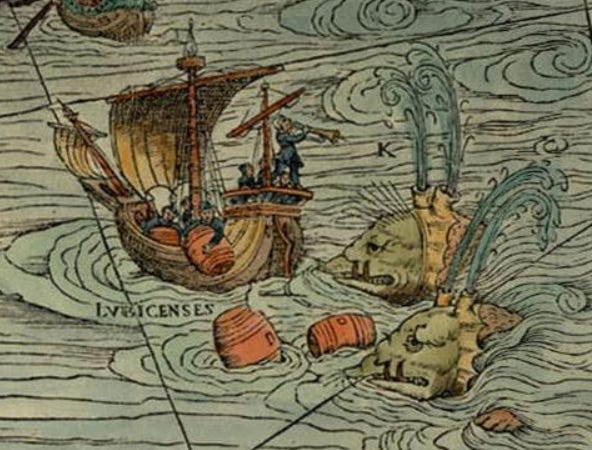
Pristers
Pristers, also known as spouters, were giant, aggressive whales populating the perilous waters of Carta Marina. Olaus Magnus recounted them as 300 feet long leviathans with ”forbidding nature” that were notorious for attacking and capsizing numerous ships. Pristers had two tubes or blowholes on top of their heads from which they could shoot torrents capable of sinking even the strongest ships. In Carta Marina you can see two pristers attacking a Lübeckian ship in this manner near the coast of Iceland.
Olaus Magnus based his description of pristers in whale sightings as well as classical and medieval writings. Following Dominican friar and encyclopedist, Vincent Of Beauvais (d. 1264), Olaus Magnus claims pristers being so immense in size that when they rose above the sea waves they resembled a massive pillar. He also quotes Strabo (c. 64 BCE - c. 20 CE), a Greek geographer living in Asia Minor and the writer of Geographica. In his book Strabo narrated how Nearchus, the commander of Alexander the Great’s (356 BCE - 323 BCE) fleet, came face to face with these giant whales. According to Strabo, pristers were able to cause enormous waves and while spouting water, they could create mist so dense that people onboard ships couldn’t see their hands in front of their faces. The third source depicting the ferocity of pristers referred to by Olaus Magnus was an Italian born chaplain and historian working in the court of Castile. He was Peter Martyr d’Anghiera (1457-1526), author of De Orbe Novo chronicling early years of Spanish exploration, conquest and colonization. In his writing Peter Martyr recounts a humongous monster, perhaps a fish, shattering a galleys rudder into pieces with one blow from its tail. He also narrates how a sea monster dragged an adult man sleeping on a beach into the sea and under the waves.
While dangerous, pristers were not invincible though. Following Strabo’s accounts Olaus Magnus instructs sailors to scare away the murderous monsters by making loud noises with for example shouts or trumpets. He quotes Strabo’s description how commander Nearchus directed his ship straight to the sea blocked by pristers. Nearchus’ trumpets terrified the beasts and sent them fleeing into the depths. Olaus Magnus illustrated this in Carta Marina by having a sailor onboard the Lübeckian ship hold a trumpet preparing to scare away the attacking pristers.
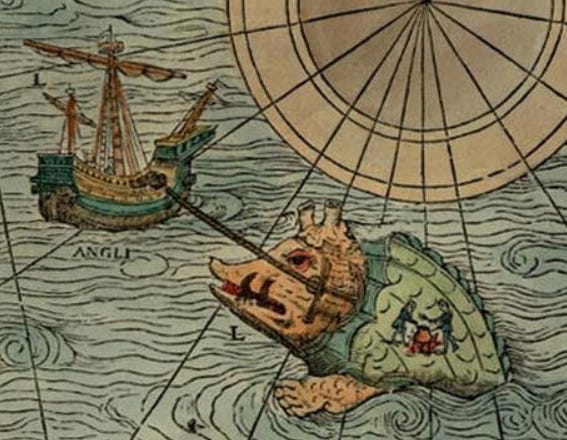
The island whale
Between the Norwegian sea serpent and pristers in Carta Marina is pictured an especially treacherous monster known as the island whale. Other names of this giant are the witch whale (trolval) and the devil’s whale (teufelval). Olaus Magnus depicted it as an enormous whale whose skin resembled ”sand on the seashore”. He continues the account by describing how the island whale often lifts its back up from the water. Sailors searching for an island to rest at see the sandy apparition. Thinking they have found what they seek, sailors anchor their ship, attach it with stakes and light fire in order to start cooking their meals. The island whale has been perfectly still until it feels the heat. The massive whale plummets rapidly under the waves. Poor sailors have only a few moments to make it back to the ship lest they drown. Even this wouldn’t necessarily save them. Olaus Magnus points out that unless the anchor breaks, the island whale takes not only men but also their ships to the depths with it.
This is exactly what’s portrayed happening in Carta Marina. In the map an English ship has anchored on the back of the island whale. Two unsuspecting sailors climbed on what they thought was dry land and lit fire. The Furious whale, feeling the heat, is facing the intruder.
Like the previous two sea monsters, the island whale wasn’t either created by Olaus Magnus. It is an ages old legend told by sailors and written about by famed names. Olaus Magnus drew from earlier works such as Hexameron, written by St. Ambrose (c. 339 – 397), Bishop of Milan. This prolific writer emphasized the gargantuan size of the island whale. According to St. Ambrose, island whales were not found in shallow waters but instead they swam in the middle of Atlantic Ocean where no land was on sight. St. Ambrose described island whales as very territorial and loving their homes ”as if it were their native country”.
The island whale was already described in the legend of St. Brendan the Navigator. St. Brendan’s legend can be found in the renowned Piri Reis map (1513). The map received its name from Piri Reis (born between 1465 and 1470, d. 1554), the Ottoman admiral and cartographer who had significant influence on the art and science of cartography. When looking at the Piri Reis map one can find St. Brendans legend gathered from the mappae mundi in the upper part of the map. The legend describes how St. Brendan, early Irish saint and legendary explorer, during his travels mistook a huge fish for dry land and made fire on its back. The heat of fire irritated the fish, making it plunge back under the water.
These three were not the only sea monsters of Carta Marina, merely the ones I wanted to introduce in this post. Together with other sea monsters such as the sea swine, the rosmarus and the ziphius they haunted the seas instilling fear in seafarers.
Safe travels and favorable winds,
Piia
Further reading:
Olaus Magnus (1555): A Description of the Northern Peoples Volume III.
Ulla Ehrensvärd (2006): Pohjolan kartan historia - myyteistä todellisuuteen. Also published in English as The History of the Nordic Map - From Myths to Reality.
Joseph Nigg (2013): Sea Monsters - A Voyage around the World’s Most Beguiling Map
Jerry Brotton (2014): Great Maps - The World’s Masterpieces Explored And Explained
And what's your thoughts on dragons.
They say legends have an ounce of truth on them, I'm really curious of the truth from these monsters or were they just a result of an imaginative person.